Wednesday, August 24, 2016

"Sunlight and Vitamin D: Necessary for Public Health" An Academic Review

And now for something completely different, I'm going to nerd out and share an academic article with you. Don't worry, though, I'll make it painless; you really do need to know about this.

(Note for readers: if you want to reference the study I'm writing about, there are quotes in italics throughout and a link in the next paragraph.  If you just want my summary and opinion, that's in plain text.)

Writing in the recent Journal of the American College of Nutrition, a group of authors have published "Sunlight and Vitamin D: Necessary for PublicHealth."  Head on over if you'd like to geek out on the whole thing, but I'm going to give you the most important points.

Basically, the authors examine the fact that many recommendations from the American Cancer Society, the World Health Organization, and the like, focus on encouraging sun avoidance and sunscreen use during the very hours of the day that our bodies are most primed to make use of the sun:

"Though these recommendations, all focused on reduction of skin cancer, are accompanied by brief acknowledgement of the importance of vitamin D for health, they persist in urging avoidance of the sun at the precise times when vitamin D can be synthesized in the skin—the hours between 10 am and 3 pm—and suggest that all necessary vitamin D can be obtained through food and dietary supplements."

And yet, there are compelling reasons to get your Vitamin D from the sun. Take a look at this introductory paragraph:

"These recommendations are understandable from the viewpoint of preventing the 3.5 million new cases of and 2000 deaths from nonmelanoma skin cancer in the United States each year, but they neglect the fact that we have a long cultural history of appreciation of the sun and use of UV radiation for healing purposes. Moreover, they neglect that we have evolved with physiological adaptations to help protect the skin from the sun when we are mindful of our exposure and do not burn. They neglect the fact that increased sun exposure, based on latitude, has been associated with protection from several different types of cancer, type 1 diabetes, multiple sclerosis, and other diseases. They also neglect the fact that exposure to the sun induces beneficial physiological changes beyond the production of vitamin D. Though adherence to the current sun-protective recommendations would likely result in the reduction of nonmelanoma skin cancer, that reduction would likely be overshadowed by the potential reduction in deaths from other cancers and from cardiovascular disease, which could be achieved by doubling average blood concentrations of 25-hydroxyvitamin D (25(OH)D) to 40 ng/mL through a combination of sun exposure and supplements."

Let's break that down a bit.  Basically, we're saying that, in our zeal to protect ourselves from approximately 2000 nonmelanoma skin cancer deaths a year, we are turning our backs (no pun intended) on our cultural and biological adaptations that allow us to appreciate the sun and use it for healing. Additionally, we are increasing our risk of other types of cancer, type 1 diabetes, multiple sclerosis, and other conditions.

For example, look at these benefits:

"When the skin is stimulated with UVA radiation, nitric oxide is released, stimulating vasodilation and lowering of blood pressure. During active exposure to UVA, diastolic blood pressure in one study fell by roughly 5 mmHg and remained lower for 30 minutes after exposure. A reduction of diastolic blood pressure by 5 mmHg decreases risk for stroke by 34% and coronary heart disease by 21%."

"Additionally, human skin produces beta-endorphin in response to UVB exposure; these opioid peptides have the result of increasing a feeling of well-being, boosting the immune system, relieving pain, promoting relaxation, wound healing, and cellular differentiation. Light signals received through the eye regulate production of melatonin and serotonin for circadian rhythm control and also play a role in seasonal affective disorder."

Short form: sunlight contains both UVA and UVB radiation.  The UVA radiation can lower blood pressure enough to decrease risk for stroke and coronary heart disease. UVB radiation can improve mood, help with certain depressive conditions, improve the immune system, relieve pain, and help with healing.

Are we sure we want to keep avoiding the sun?

Look, no one is going to tell you to go try to get a sunburn. And if vitamin D supplements make sense to you, go for it.  But the sun has been getting a bad rap lately.

And, there are reasons for seeking the sun:

"The full solar spectrum is essential to optimal health and well-being. Humans are physiologically adapted to produce vitamin D in response to sun exposure, specifically UVB radiation; other regions of the spectrum seem to confer benefit as well. Though some vitamin D comes from our diet (and more recently from supplements), we should not ignore the natural capacity that we possess to produce our own. We are of the opinion that moderate sun exposure (less than the time required to burn) to the arms, shoulders, trunk, and legs should be sought rather than avoided."


I agree with the authors.  Bottom line, the full spectrum of sunlight seems to confer many health benefits, and our bodies are designed to make vitamin D from this exposure. So go outside wearing a tank top and shorts. Mow the lawn, hang the laundry, take a bike ride. Do so between the hours of 10 am and 3 pm for maximum formation of vitamin D.  As long as you don't allow yourself to burn, you will very likely be helping your health far more than you might possibly harm it.

Pin It!

Monday, August 15, 2016

How Much Does a Garden Grow: July

Oh, my gosh.  Seven months in, and we're still not in the black!  But more on that in a minute.

One thing that's wonderful about July is the variety of veggies that start becoming available.  Of course, there was a really awkward few days when I was harvesting nothing but zucchini and blueberries, which was kind of confusing come dinnertime, but mostly I've been bringing in baskets that look like the one at the right.

Almost the full range of vegetables has become available, except for carrots and beans, for whatever reason this year. Some interesting highlights:

  • So far, I've harvested nearly $24 of greens this year, although most of that was before July. It's time to start the next round now that it is likely to start cooling down a bit.
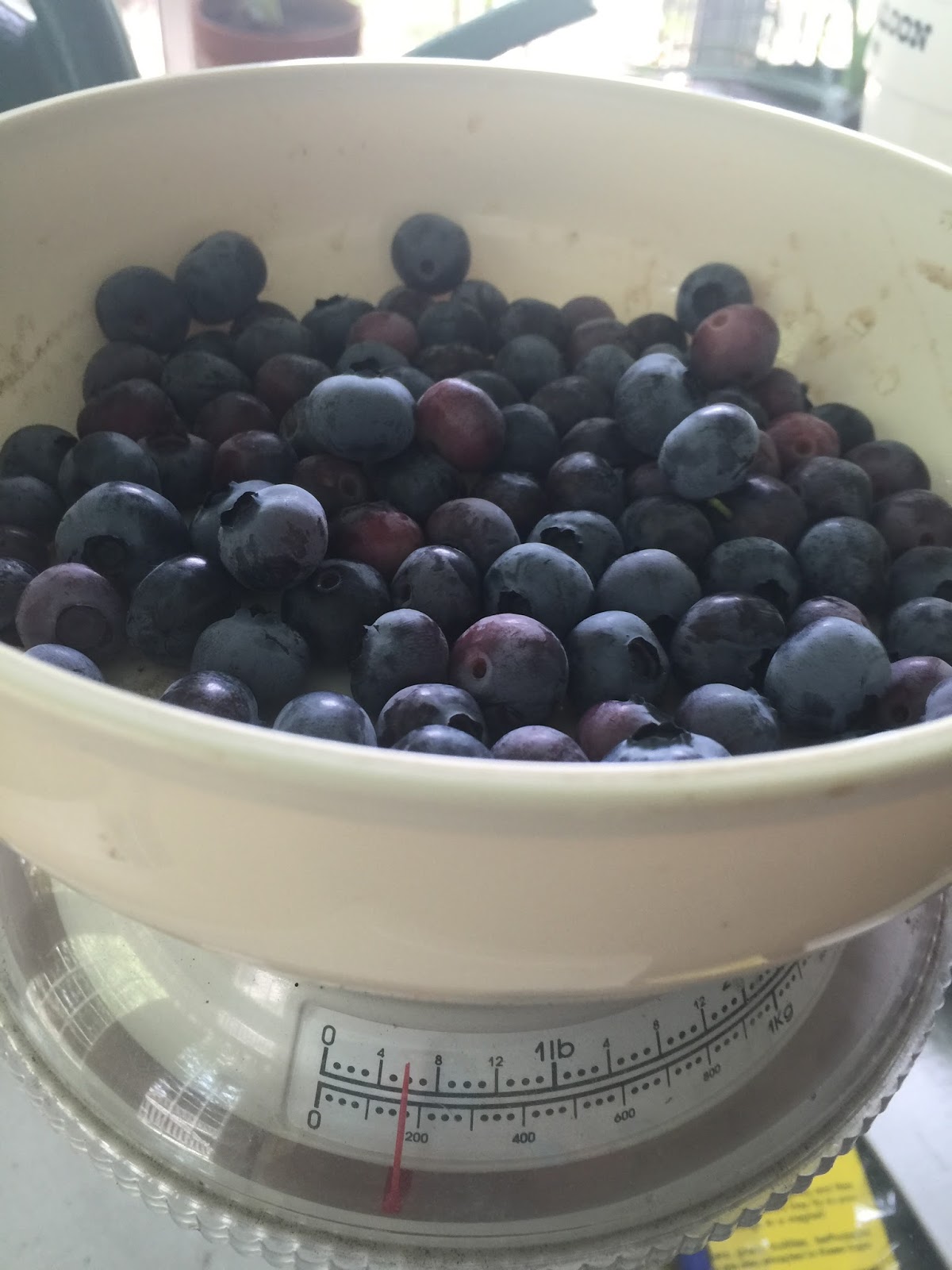
  • The final blueberry tally stood at 81 ounces, or nearly $31 worth. As someone who just dropped $40 at the farmer's market on fresh fruit, I appreciate every bit of fruit I can get out of my little patch.
  • Zucchini and cucumbers are my big monetary producers as always, with over $31 of zucchini so far and over $25 of cucumbers. This is in spite of the fact that some of my cucumbers seemed to die from the heat wave we had. I'm experimenting with a late crop of cukes in the grow boxes.
  • We've had some early stand-outs in the tomato patch. A beefsteak plant I bought for $5 has so far given me over $15 of tomatoes, and an early San Marzano I also bought for $5 has given me $15 worth of fruit; that makes way for my later San Marzanos that I've grown from seed.
So why are we still in the red? A couple of reasons.  First is that the garden has shrunk by about a third due to the fact that an oak tree's shade now makes part of my patch too shady to grow anything. I have my eye on a pine tree out front that should come down and would make a lovely front yard patch, but that would be next year at the very earliest. I've tried to compensate with containers, but I haven't been able to make up the difference yet.

Also, since I lost the space to the shade, I've had to get rid of some of our less-loved but more profitable crops, like the butternut squash. Those always were worth a lot, but we didn't crave them quite as much as we do some of the summer veggies.

Regardless, even if we're not canning as much as I would like, we are certainly eating veggies like crazy. I'm hoping that the lack of a robust buffer of canned goods doesn't hit our budget too hard this winter.

Cumulative Totals:

Expenditures to Date: (-$204.08)

Total Ounces Harvested: 564.5
Total Pounds Harvested: 35.28125
Total Value of Harvest: $144.20

Total Profit (Loss): -$59.89

Pin It!

Monday, August 8, 2016

Sustainable Sanity: The Pacifica App

(Part two of our discussion of sustainable sanity!)

Do you ever have one of those days? You're in a foul mood for one reason or the other, and someone goes and does it: they post a meme to Facebook or Twitter that says something unbearably chirpy.  You know:

  • I think you're as happy as you make up your mind to be!
  • Do what you love and you'll never work a day in your life!
You know the memes.

Now, before I scare all of my optimistic-meme-posting friends away, let me say that I get it.  I do. There's a lot of truth in these sayings. You can do a lot for your mood by just deciding to try to put a positive spin on things; those of us who are lucky (or hard-working, or both) enough to have found or made jobs we enjoy are certainly in a better place than those who just intrinsically hate their jobs.

But man, some days, there's nothing like being told that your bad mood is the result of poor emotional control or lousy life choices to really kick you when you're down.

While I think there's a lot you can do to think yourself into a good mood, I really believe that it's a lot easier to do so when you have factors set up in your favor. And so, I recently started using a mood-tracking app called Pacifica, available on Apple's App Store and on Google Play.  I believe one of their tag lines is "no judgement, just data," and that's what they provide.

The app is designed to use the principles of cognitive behavioral therapy to help manage anxiety and depression, but I think the app is useful for anyone, as I can attest.  On the the free version, you have a screen that allows you to set certain generalized goals in certain categories, as you can see on the screen shot; the categories are sleep, exercise, eating, water, caffeine, and (not shown) outdoors, and medication.

But the beauty of this is that you set your own goal, and there's no nagging involved. You can see above that I have set a goal of two glasses of water a day, which I hadn't met when I took this screen shot. I picked two because I drink a lot of other liquid and eat fruits and vegetables that are loaded with water, so I felt pretty good about trying for two glasses of clear water or seltzer; the app did not nag me to try for eight, which would be unrealistic for me right now.

Or take something like exercise.  I'm going for 60 minutes a day, but the app doesn't nag me to say that so much of that has to be cardio or that it all has to be yoga; I'm in charge of what I count as exercise and how.  The same is true for eating; it operates on a very general scale of poor to perfect, but you are in charge of what that means in your life.

On another screen, you can track your mood on the same sort of generalized scale, and you can record multiple mood entries per day.  Over time, you will start to amass enough data to see if your best mood days correlate with certain behaviors in your life.

So, for me, I've seen that my best moods are on days that I've gotten eight (and ideally 10 or more) hours of sleep, have been outside for an hour or more, and have exercised for an hour or more.  I don't think this is a surprise to me, but now I have some tools at my disposal. If I'm feeling my mood slip, I can think about whether I need a workout or a nap or something else that might help bring me back into balance.

Now, this is all going to be challenging in the winter, when there is no sun and very little chance to exercise outdoors, but it certainly means that I'll be taking advantage of every acceptable day to at least take a mile walk and breathe some fresh air, and I plan to reactivate the gym membership when gardening (and outdoor exercise) is over for the year and start treating myself to my favorite classes.

Your mood is as much a sustainable resource as anything else, so it makes sense to treat it as such.  I encourage my readers to try this app; you may learn something that makes you happy enough to post all sorts of memes to Facebook!

(Note: This is not a compensated review; I downloaded the free version of Pacifica and have shared my own opinion.)
Pin It!

Monday, August 1, 2016

The Power of Going Outside

Normally, this blog focuses on sustainable use of resources like time, money, food, and fuel; all important things. But for the next couple of posts, I'm going to focus on something else that's easy to use up and hard to get back: your sanity. Because I've become at least half convinced that our modern lifestyle is killing us.

Think about what we do every day. Now, I'm lucky, in that part of the year I have the freedom that comes with self-employment and good weather to take a bike ride to the grocery or to see a client, but the majority of us are stuck for several hours in a day sitting in a chair behind a desk staring at a screen. Everything is square and backlit and makes strange beeping noises, particularly when you get email that explains why this deadline has been moved up or that client needs something right away or another person needs something fixed. These things may be our financial lifeblood, and they may even provide a degree of career satisfaction, but, no matter how benign, they take a toll on our health.

Take this new study out of Australia that goes a long way toward quantifying our need for nature in our lives. According to the research, if everyone visited a park for just 30 minutes once a week, there would be "seven percent fewer cases of depression and nine percent fewer cases of high blood pressure."  That's pretty specific, but it does point out that we can get a lot of benefit from even a little exposure to nature. It also maybe suggests that if corporations were really serious about employee health, they'd make sure they had some green space and encourage everyone to use it.

Of course, it's difficult sometimes. In the winter, I often think of Papa FC&G, who used to work in a windowless office. In the winter, he'd go to work in the dark and come home in the dark with only glimpses of the sun. Needless to say, my sun-loving father always had trouble with this arrangement.

The fact is, our bodies -- and that includes our minds -- need the outdoors. We evolved to want the warmth of the sun and the development of vitamin D in our skin. We spent millennia evolving a comfort with irregular, organic shapes and leafy green canopies above our heads. We have a visceral memory of the comfort of salt water, the salinity of which is echoed in every cell in the human body. We love nature because we evolved to be a part of it.

Now, I'm not arguing against progress. Believe me, I like central heat and ready supplies of food and electronic gadgets as much as the next person. But we all have to take time to touch base again with nature. Our minds will thank us for it.
Pin It!

Thursday, July 21, 2016

Cheddar Dill Zucchini Cakes

Are you getting enough zucchini in your diet?  If not, you're probably not growing them. Or, you are having a bad zucchini year. Otherwise, you are no doubt looking for recipes for zucchini all the time.

These zucchini cakes are based on the traditional recipe for salmon croquettes (which we call salmon patties) that is my favorite. They will bake up a little soft because of the zucchini and cheese, so let them sit a bit before serving. They reheat for lunch like a dream.

Cheddar Dill Zucchini Cakes
1 medium zucchini, shredded
1 T. canning salt
1/2 sleeve saltines, crushed
1 cup shredded cheddar cheese
1 egg, beaten
1 tsp. mustard powder
2 tsp. dill.

Preheat oven to 350. Shred zucchini, salt with about 1 T. canning salt and let wilt about 10 minutes; rinse thoroughly.

Combine zucchini with other ingredients and place on greased baking sheet in baseball-sized, flattened patties.  Cook 30-35 minutes, flipping over at the halfway point.

Makes 5-6 patties

The Analysis
Fast:  These are quick to put together, especially if you just have to run out to the garden for a zucchini.

Cheap:  Basic ingredients keep our costs under control here.  Pay up for the free-range eggs and organic cheese, if you can.

Good:  Good as a dinner side dish; even better the next day.

Pin It!

Thursday, July 14, 2016

How Much Does a Garden Grow: June 2016

It was all about the blueberries this month in the garden!

I love a June garden. July and August can almost be an embarrassment of riches (and I love that, too), when you are hopefully bringing in baskets of produce and trying to figure out ways to cram more veggies into your diet and more time for canning into your schedule.  But in June, harvests come on one by one, and you gorge yourself on one thing while hoping eagerly for the next.  There's nothing like having a cereal bowl full of blueberries every night while you obsessively check the garden to see if you can get a single zucchini yet.

And that's pretty much how June was around here. During the month, we brought in 61 ounces of blueberries, nearly a half gallon.  (Spoiler: we'd pass the half gallon mark the next week.)  I don't think that's bad for two mature blueberry bushes and one tiny one. Mr. FC&G had blueberries on ice cream almost every night, and I ate them straight out of a cereal bowl. Going by the prices at my local farmers' market, I harvested $23.18 worth of blueberries.

We also had some other produce come in: a few cents worth of peas that came from a plant I started from leftover seeds in utter gardening frustration in about April, and a regular influx of greens.  I've been letting the kale take a break lately, but it is almost time to start cutting on it again.

With no expenditures this month, we are clawing our way toward profitability.  Totals are below:

Cumulative Totals:
Total Ounces Harvested: 90.5
Total Pounds Harvested: 5.65625
Total Value of Harvest to Date: $45.18

Total Expenditures: ($204.08)

Net Profit (Loss) to Date: ($158.90)
Pin It!

Friday, July 8, 2016

In Praise of a Clover-Filled Yard

I was talking to Papa FC&G the other day, and he recounted a story from his grandfather ("Pop").

When my dad was building his first house, Pop told him that he should be sure that he mixed plenty of clover in with the grass seed when he seeded the lawn. According to Pop, the clover would "sweeten" the soil, which was a desirable thing to have happen.

When did we start hating clover in our lawns?  Pop was right, you know. Clover is one of the crops that fixes nitrogen in the soil, making it easier for other nitrogen-loving plants to grow.  In fact, we are often happy to see some clover creep into our garden, although we usually have to get rid of it to make room for veggies.  However, when we do, we use the hoe and cut it off at the surface, leaving those nitrogen-filled root rhizomes in place.

Clover is pretty, too. Remember picking your mother a bouquet of clover and bringing it into the house? I sure do.  I loved to follow those slender stems down to the ground and picking the fluffy little white flowers, which Mom would always put in a special tiny vase (which I believe was a crystal toothpick holder).  And I spent countless summers looking for a four-leaf clover. If you have kids, you should have at least one huge patch of clover just for the entertainment value.

And the bees! We all know we've had problems in this country with colony collapse and a lack of bees to pollinate our fields and gardens. Growing a special "bee and butterfly" garden of flowers is great, but if you also let the clover grow in your yard, you will attract bees like crazy. In fact, we have one special patch of clover just outside the garden that we tend to "forget" to mow about every other time, and it attracts bees to the flowers. From there, it is a short hop over to the cucumbers, zucchini, and tomatoes, and I regularly find bees nestled in the veggie flowers. Yes, I get stung about once a year, but it is generally from a bee that I've stepped on, which seems fair to me. The bees that are already happily gorging in the veggie flowers usually leave me alone if I do likewise, and they tend to be docile, sated, and amenable to a gentle brush of the hand to move them if I really need to get into that plant.

Finally, clovers is a very economical kind of ground cover. Unlike grass, clover simply doesn't grow very high, so the more patches of clover you have in your yard, the less frequently you have to mow and the easier the job is. We have one side of our yard that is currently about half covered with clover, and it is the easiest section to mow and the one that needs it the least.

My temptation when I started this piece was to rail against herbicides and growing grass in monoculture, and I probably will do so another day.  But, on this fine summer day, I'm going to enjoy looking at my yard full of clover. Pop was right: in so many ways, it makes the yard sweet.
Pin It!

Monday, June 27, 2016

It's All About the Greens and the Blues

June has been all about the blueberries and the greens, two crops that are insanely expensive to buy at the grocery and the farmers' market.  Around here, a 5 oz. clamshell of pre-washed organic greens can go for about $4, while a pint of blueberries at the farmers' market this week was $6.  That makes these two early crops some of your best bets for saving money while boosting nutrition and eating more locally, to say nothing of the boost to your self-sufficiency.

We've talked about growing greens already this month, but growing blueberries can be fairly low-effort as well.  Your biggest task will be protecting the fruit from birds, which we will discuss.

Blueberries come in early, mid-season, and late varieties, and many growers like to have a mix to extend their blueberry season.  As it turns out, the only blueberry bushes I have that survived a couple of icy winters are early varieties, so that's what I'm going with.

Often, your bushes will need pollination from another variety, so be sure to check the tag or the catalog description to make sure you are buying enough varieties to secure a good crop.  I like Stark Brothers as a source for my fruit trees and bushes, because they are so good about telling you what varieties to buy together.

Blueberries famously love an acidic soil, so they can be challenging in lower parts of the Midwest like where I live.  I mulch them once or twice a year with pine needles, which will acidify the soil a bit over time.  Currently, I have one really large, mature bush and two that are just a bit smaller. From just these three bushes, I've been bringing in somewhere between three and six ounces of blueberries a day for a couple of weeks, which is enough for me to have a cereal bowl full of blueberries every night and Mr. FC&G to have some on his ice cream.  It may not sound  like a large harvest, but if I bought this amount at the farmers' market, I'd be spending around $1.50 a day on blueberries.  It adds up, especially when you are a writer with a variable income and delusions of needing to buy beachfront property.

The one task you will have is protecting your ripe fruit from the birds.  Mr. FC&G has experimented with several netting and cage designs, and I think he really hit on a winner this year: a three-sided structure made out of tall garden stakes and fine-gauge fencing, with netting over the top and front.  I can just push the netting aside to go into the enclosure to harvest.  Right now, that structure is over just one bush with an old pop-up tent over the other two, but I have plans to, ahem, encourage him to expand it.

Blueberries do take a couple of years to get large enough to bear fruit, but once they do, they will be an early-season source of savings, sustainability, and self-sufficiency.

Pin It!

Wednesday, June 15, 2016

What You Need to Know about Growing Greens

For this post, I have to give an anonymous shout-out to one of my friends who asked about techniques for growing lettuce, or, more specifically, greens. (I use the term "lettuce" to mean only certain varieties of leafy greens, while "greens" to me also encompasses the tasty, hearty leaves that are sometimes called "potherbs" because they cook up well.)

If you grew up in the 1950s, 60s, 70s, or 80s, your mental picture of lettuce is probably of a head of iceberg lettuce. While this kind of thing is ideal for cutting into wedges and making a "so old it's hip again" lettuce wedge salad, head lettuces of any kind are often not your most efficient use of your gardening time or money, to say nothing of the fact that you are neglecting an entire group of greens that will just grow and grow for an entire season.

Let's talk a little about the basic types of greens, or lettuces.  Most common, as I suggested, is the head lettuce. Iceberg is one such variety, but so is romaine and bibb.  These lettuces grow a head that you then cut off at the soil line. The benefit, obviously, is that you have an entire head to make a large, family salad, and many of these lettuces have highly-desirable flavor profiles that are mild enough to make them great for sandwich wraps and to serve as a background for the traditional tossed salad. The downfall is that, once you cut the plant off at the soil, it is probably done. Romaine will often regrow at least once, and some of the others may send up a few additional leaves, but your primary harvest is done.

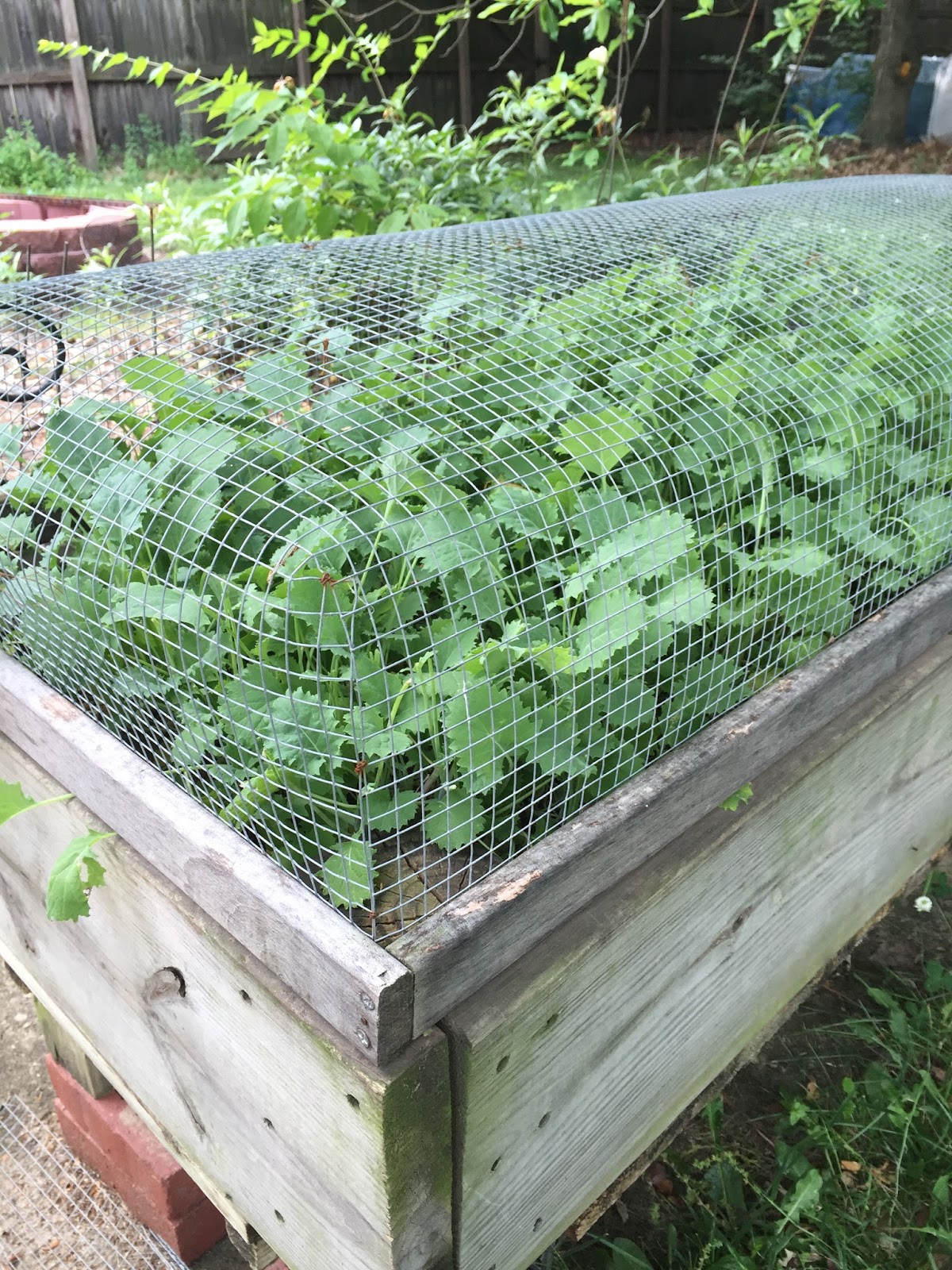
The second type of green has the homey name of "cut and come again." These are greens that do not form heads, but instead send up individual leaves for you to harvest. These include some of the heartier, more flavorful greens, like kale (seen in the photo), spinach, and arugula. The downfall of these greens is that you may be standing over your lettuce bed trimming and trimming and trimming to get a decent-sized salad.  The benefits, though, are incredible.

Let's start with the fact that these greens let you really customize how much you harvest. Instead of taking the whole head, you can easily pop outside and get a handful of greens for your sandwich, something I do almost every day. They also really let you decide the stage of development at which you like your greens best. Here's a tip: if you think you don't like kale, grow some and harvest it when it is no bigger than a silver dollar instead of waiting for the big, thick, curly leaves. The flavor is actually sweet, with just a little bit of bit. It has many of the benefits of microgreens, just a little older. These greens are also very container-friendly, so you can easily grow a pot full on a windowsill or a back patio as long as you get a lot of sun. (Note: I do grown greens in the winter, too, since they are very cold tolerant, but they grow much more slowly in our sunroom, even with a grow light over them.)

Which brings me to the primary point: these greens are ultra-sustainable. Cut them (without killing an entire plant, hence the snip-snip-snip technique), and they will regrow and regrow for months at a time. You've done one planting for a good 6-8 months of harvesting. And these greens are really economical: this bed full of kale that you see above comes from a single pack of organic seeds (that I bought at Whole Foods, so I'm hardly low-balling this calculation) that I bought for $1.89. Bags of pre-washed, organic, baby greens sell around here for about $0.88 per ounce, and I've been bringing in a half ounce to an ounce every day.  I only need to harvest three ounces to be in the black with this crop, and I passed that the first week I could harvest.

So, there you have it. Hopefully, most of what you ever wanted to know about growing greens, sustainably!

The Analysis

Fast: These greens grow quickly in the summer, ready for initial harvest in 3-4 weeks; they take longer in the winter.

Cheap: See the calculation above; these are almost instantly profitable.

Good: Not only are these little guys tasty, but they give you a lot of nutrition and will keep doing so for the entire summer and well into fall!


Pin It!

Wednesday, June 8, 2016

Random Thoughts on a Wednesday

Today, just some random thoughts about the sustainable lifestyle we try to lead around here:

  • Feverfew (seen at the right) is so pretty, I'm starting to expand my plantings from just the medicinal ones that I have in the back garden to some more decorative ones out front that are allowed to bloom. I have my eye on a spot that has been a pain to deal with for a couple of years; some perennial feverfew ought to do the trick. And it is so pretty to bring into the house for bouquets!
  • What a lovely week it has been for biking! You know (oh, boy, do you know!) that I'm not a big fan of this part of the country, but I am glad that we live within biking distance of the grocery, the post office, and the college where I teach. It is so nice to bike to those places during warm weather.
  • My two-year-old leeks are about ready to bloom, which is either a beautiful addition to my front yard flower bed or an indictment of me not being able to get myself to go harvest them this winter and throw them in a stock pot. At this point, they are far too woody to be used in anything else.
  • If you believe the news reports that the economy is in good shape, just do a financial audit on your non-essential services. I've started reviewing things like video streaming, DVR, gym membership, and the like, and cancelling the things we aren't using. Almost every one of those calls that I have made have included the company offering to "pay my bill" for a number of months if I need a break from it. That tells me that there are a lot of middle and upper middle class people who are looking for places to cut costs.
  • We are starting to bring in blueberries and peas, and the thought occurs that harvesting is so satisfying that it must be hardwired into the human brain. Along with visual, olfactory, and taste cues, there must be a tactile component to food that makes us instinctively focus on keeping ourselves fed.

Pin It!

Tuesday, May 31, 2016

How Much Does a Garden Grow: May 2016


So May is gardening in earnest!  And, I swear, I didn't think I was ever going to get that garden in! It was so cold and rainy, and I had this pile of plants waiting in the sunroom to go out, and I was going nuts! The only thing that kept me even partially sane was that my neighbor, who raises probably 50+ beautiful, textbook-looking tomato plants every year, just got his in the ground this weekend too.

With everything going in late, I expect some of the harvest to be delayed too. I do have a few really large tomato plants I've been buying one at a time from a guy who reputedly grows some of the heaviest-bearing tomatoes in the area, so we'll see. My container tomatoes, which went in on May 1 and were protected by a makeshift cold frame, are also doing really well.

As you can see at the right, the cold didn't really hinder the herbs. I'm already drying sage and feverfew, which are very important to the overall system. Feverfew, especially, is critical, because I've found that it works for migraine prevention for me better than prescription medications with fewer side effects. (Note: always talk to you doctor, not your blogger, about treating your migraines.)

Overall, the harvest was limited to kale and spinach, of which we harvested 7 oz this month.  That's more than a bag full from the grocery, so definitely a savings.

But I'm so looking forward to June!  I hope that we really get to get into some harvests and start making (saving) some money! Let's get this garden in the black!

Cumulative Totals

Total Expendatures: ($204.08)

Total Harvest Ounces: 15.5
Total Harvest Pounds: 0.96875
Total Value of Harvest: $11.75

Net Savings to Date: ($192.33)
Pin It!

Thursday, May 19, 2016

My Cycles of Sustainability

I have a confession: Along with many other sustainable living experts, authors, and bloggers, I'm guilty of making it sound like sustainable living can be broken down into a lot of little projects, with a huge focus on gardening, food preservation, and vintage-style domestic arts.

This is true, to some degree. But, if you don't take a systemic view of your lifestyle, you may find that you have simply changed your daily activities without making a noticeable improvement in your life.

Remember our fundamental purpose: sustainable living means responsible use of resources. Resources include food, clothing, land, environment, time, money, health, or anything else that you may have a demand for that exceeds the supply.

To that end, I thought it might be useful to share the overall structure of my year, which I divide into three "seasons."

Season One (January-April): Focus on Earning
The winter months are cold and dreary around here, and, as you are probably painfully aware if you have been reading this blog for any amount of time, I am not exactly a cold-weather person. Therefore, I find it helpful to throw the majority of my energy behind projects that maximize my income, since it's too cold outside to do much in the way of gardening.

Major Activities
  • Work on as much writing for Hilltop Communications as possible.
  • Take on extra teaching assignments.  This winter term, I taught eight credit hours of classes in addition to my primary writing biz.
  • Add photos to the Cucumber Key Photography web site.
  • Continue to sell and work on restocking the Carrot Creations store.
Minor Activities
  • Start garden plants.
  • Do non-vegetable canning, like stock from meat bones.

Season Two (May-August): Focus on Saving
This is my favorite season. Nearly every day brings time in the garden, and I have more time to work on various projects. During this season, I focus on projects that will either generate income or save time or money in the coming months.

Major Activities
  • Keep the garden in full production. 
  • Make as many meals as possible from primarily garden products, reducing expenditures for food and improving health.
  • Preserve as much food as possible, reducing future food bills, speeding future meal production, and improving health.
  • Buy food I don't grow at the farmer's market, with lower in-season prices. Preserve any extra.
  • Institute energy saving projects, like drying laundry on the line, using passive solar heat to warm the house or open window to cool when possible, and taking advantage of long days to avoid using lights throughout the house.
  • Work on writing projects that will sell year-round, for a passive income stream. Right now, my focus is on my book-length projects.
  • Continue to maintain regular writing and photography work.
Minor Activities
  • Split wood for fall home heating, when there are many days we can heat exclusively or primarily with our wood stove.
  • Continue to stock the Carrot Creations store.
  • Catch up on seasonal home projects that weather or time constraints will make impractical later, such as weatherproofing, necessary home improvements, or even just washing and line-drying all the quilts and bedding in the house.
  • Conduct "expenditure audit," looking at things like cell phone plans, video streaming service (Netflix) useage, gym memberships, and the like, and cancelling or altering the things that no longer fit our needs.

Season Three (September-December): Focus on Processing
I've been in academia so long that I almost reflexively think the year begins in September. This is the season that many of the projects I've worked on all year pay off and I have time to think about the next cycle.

Major Activities
  • Process orders in the Carrot Creations Christmas rush. Crochet like a mad woman to continue to keep existing stock in the store as high as possible by replacing items as they sell.
  • Plan meals around canned, frozen, and still-growing garden products and other such preserved food (like chickens purchased "in season" over the summer at harvest time). Attempt to keep grocery bill low by relying on food in stock.
  • Pick up teaching load again.  Typically, my fall semester load is lighter than my winter/spring one, but that can change according to need.
  • Continue to write and photograph.
  • Institute heat-saving and -generating measures around the house, like use of the wood stove, venting the dryer inside, using passive solar heat, and getting those freshly sunned quilts out of the closet.
Minor Activities
  • Generate ideas for future writing projects.  Keep a OneNote file on each so that I can work on them year round as time permits.
  • Focus on non-food sustainability projects like rebatching soap.


And that's the system.  Is there a project or practice you'd like to see me detail in a future post?  Let me know in the comments or on the Facebook post.
Pin It!

Wednesday, May 11, 2016

What Happens to the Regrown Romaine?

I never imagined the degree to which my post on regrowing romaine would capture people's imagination.  It is well on the way to being the most popular post I've written, along with the post on the fleece unquilt.  This makes me happy, because, taken together, it indicates that there are a lot of people interested in making the most of things that others would throw away.

So, here are some answers to questions I've received from readers:

Q: Do you have to regrow your romaine heart in dirt?

A: The post on regrowing romaine has been picked up by several other blogs, and many of them indicate you can regrow a romaine heart in water.  You probably can.  However, I choose to put the cut off heart in soil because plants generate some of their nutrients from the soil.  I want the healthiest product available, so it's no big deal to just jam the heart into some soil and watch it grow.

Q: Does the heart root?

A:  Yes, if you place the heart in dirt, it will start to develop roots.  This allows it to grow longer and produce healthier leaves.

Q: If you cut off the new leaves, will it keep producing more?

A:  Probably not.  None of the specimens I've tried have kept growing after I've cut off the new growth. I think this stands to reason.  Romaine is not a "cut and come again" style of green that you can trim and expect to regenerate.  Instead, romaine is a head lettuce, and the intention is for the grower to cut the head at the end of the season.  We are getting something of a "bonus" head of romaine by using this trick.

Q: What is the flavor like?

A:  Pretty good, actually.  Sometimes, I find that the new head is just slightly more bitter than the "mother" that it is coming from, but I find that appealing.  I like greens with some bite to them.  If you try a leaf and decide that you have a bit too much astringency for your taste, you can always use the resulting head as a "pot herb," stirring chopped up leaves into rice or soup just before serving. That adds some much-needed nutrients to your meal while changing texture and flavor to be more mild.
Pin It!

Monday, May 2, 2016

How Much Does a Garden Grow: April 2016


Finally!  We're back into production!

I'm hoping to write a post this week about the cycles of savings and income in our household, but it should come as no shock when I note that late spring, summer, and early fall are the prime times to save money on the garden.  In fact, that's where this column got it's start: I wanted to see just how much I was saving over retail with my garden, once factoring in the expenditures.

April starts the garden investment in earnest, and this month the expenditures stand at a total of $85.08.  That will go up quite a bit (probably to the $200 range) very shortly as I buy the last of the plants and seeds for the year.

The exciting thing, though, is seeing the harvest start to come in and reduce the expenditures on our way to showing a net decrease in our food bill.  This month, it was all about the baby kale (and a bit of baby romaine).  I harvested 5.5 ounces of greens for a net value of $4.84.  This is about the weight and value of a bag of prewashed organic greens from the store, so it isn't making a huge dent in the food bill yet, but it is certainly brightening up a few meals.  I've enjoyed a great deal of this in wraps that I've made for lunches; baby kale makes a great addition to some Swiss cheese for a nice vegetarian wrap, and you already know that I've put it on some pizzas.

I'm pretty sure the majority of the harvest through May will be greens as well, as I have kale, romaine, and mesclun already started, and I want to get some arugula started as well.

But for now, I'm plenty happy with my start to savings!

Cumulative Totals

Expenditures: $85.08

Harvest Total Oz.: 8.5 oz.
Harvest Total Lb.: .53125 lb.
Harvest Total Value: $5.59

Net Annual Savings:  -$79.49
Pin It!

Tuesday, April 26, 2016

Playing with Pizzas

So, lately, we've fallen in love with pesto as a pizza sauce replacement, and boy, is this a nice way of using some of the pesto in the freezer!

Pesto is a lovely replacement for the traditional red sauce, especially on primarily-veggie pizzas like the one you see at the right.  It allows toppings like sliced tomatoes to shine, and it is a nice balance for toppings of greens, like the fresh kale that I used.

On a standard pizza crust (I'm still playing with crust recipes, but this one is promising), put 1-2 ounces of lightly-salted pesto.  If you are making your own pesto, you probably want it more lightly salted than the pesto you would use for pasta.  Since I don't put salt in my pesto to freeze it, I was fine with it as is.

Use plenty of veggie toppings.  Because it is so early in the season, I splurged on some organic tomatoes and topped them with just a light sprinkling of cheese.  Greens are a nice touch if placed on as soon as you take the pizza out of the oven; they'll wilt but not overcook.  Use hearty-flavored greens like kale or arugula; fresh dandelion leaves might be nice too.

Voila, a whole different pizza taste.  I promise it won't disappoint.
Pin It!

Monday, April 18, 2016

In the Aftermath

Well, we finally made it through the power outage around here.  Eleven days, but we came out the other side with a lot of really good improvements to the electrical system for the house. This seems to be our MO: we wait for something to break, and then we make all sorts of improvements when we fix it or have it fixed.  I've gotten a new roof and a couple of new floors that way, too.

But from a sustainable living perspective, those couple of weeks were a bit of a disaster. I should have repotted my tomato plants, but it was sleeting outside and 52 degrees in the house and I had no grow lights or warm mats for them to sit on, so I left them in their baby pots. So, that means that my tomatoes are now a couple of weeks behind. I just repotted this weekend, and they are enjoying their first days in the sun.

We also are trying a new experiment this year: asparagus. Assuming it takes, we won't, of course, be able to harvest any for a year or two, but I figured it was time to try this crop. Every year, I've wanted to put in asparagus, and every year I say that we won't be living here for the next season, so why bother? Maybe the act of actually planting some asparagus will get us to be able to move.

Gardening season is ramping up quickly, though. We're enjoying lots of fresh baby kale on sandwiches, and I'm hoping to plant some pots of mesclun tonight. Pretty soon, we'll be making a dent in our grocery budget once again, which will be a welcome event. I plan to tell you about the way we rotate our seasonal projects very soon.

Pin It!

Thursday, April 7, 2016

Prepper Dress Rehearsal


So, all the good "prepper" books and web sites tell you to be sure to practice with your gear once in a while so you are ready for emergencies. Mr. FC&G inadvertently have been running a little dress rehearsal for the past week, which, heaven willing, is almost over even as I type.

It started when we began to lose power to certain parts of the house. The local tree trimmer was working near the power lines, and we naturally assumed something had been hit or dislodged, and we waited until they were finished to call the power company.

Well, the power company came out and said that our 50 year old meter box (unsurprisingly) had taken some damage over the years, and it needed replaced. And then they unhooked all the power to the house and said to give them a call when it was fixed and took off.

So, while Mr. FC&G did the repairs (thank heavens for marrying an electrical engineer!) and we waited for an inspection, we've been living rough. But along the way, we have gotten the "opportunity" to test our preps. Some lessons:

1. It's always the first world problems that get you.
If unplugging the house meant that the entire world were unplugged, we'd have had a much easier time of it. Most of our anxiety involved running a generator to drive, in part, the computers and internet access we would need to work our jobs. Our second problem was running the refrigerator and freezer. I've been in the process of converting more of my food storage efforts to pressure-canned food for this very reason, but our expensive meat from the CSA requires us to keep running that freezer so we don't take a loss.

2. Thank heavens for the fireplace insert.
I used to hate the look of a fireplace insert until I weathered a few power outages around here. Then, I started loving the fact that I could heat the lower level main room and even cook meals on the thing. If you have a largely-decorative fireplace, I'd say a stove insert is one of the best things you can buy.

3. Your gear is not irrelevant.
Every time I buy prepper gear, I feel profoundly stupid. But every time I have to live without power, I'm grateful. In the photo above, we got out the small cast iron skillet (the large one is theoretically packed safely away in the garage in some location that we can't remember!) and the two-cup tea pot. That made things a lot more bearable.

4. I'm just putting it out here: you need more underwear.
I've wanted to buy some "travel" underwear for a while. You know: the easy-wash, quick-dry stuff you can take on vacation and wash up each evening. I figure, I'm getting tired of packing 20 pairs of undies to take a week long trip to Key West (hey, don't judge...), and 5 really washable pairs would take up less room. After spending this week waiting for a sunny-ish day to wash my unmentionables, this has risen to the top of my list.

Pin It!

Wednesday, March 30, 2016

How Much Does a Garden Grow: First Quarter, 2016

And we're back with another installment of "How Much Does a Garden Grow."  I've left this column alone for a quarter because there really wasn't much to report over the winter, but we are getting started now.

This is the season of expenditures, and thus far I've spent $53.78 on seed starting and plant orders.  I'll need lots more, of course, but this is a good start.

The interesting things is that I harvested 3 ounces of tomatoes from the plant I brought inside last fall.  I know I got about that much last year after harvest time too, proving that it is probably not worth it to purposely try to nurse a tomato plant through the winter in our climate.  However, if you have one in a container with fruit on it and a place to put it, like I did, it makes a fun diversion.

The beans did not fare so well over the winter, so I won't do that again, and the jury is still out on the pepper plants I brought inside.  They are looking rough, but they are alive.  We'll see if I manage to get them to come back this spring.

Otherwise, I have greens about ready to harvest, and I'm getting ready to plant peas in containers.  As you can see, the tomatoes are ready to be transplanted too.  So, the garden is seriously underway!


Totals

Total Expenditures: $53.78

Harvest: 3 oz./0.1875 lbs.
Harvest value: $0.75

Cumulative savings:  ($53.03)


Pin It!

Monday, March 21, 2016

Spring in the Garden

Spring has finally sprung in the garden! I've withheld doing a tally of harvests and expenditures because there was not much to write home about during January and February, but March is full of promise:


  • The garage potatoes died due to an unexpected growth spurt in the warm fall, followed by vines that didn't make it through the winter. But you know how potatoes are. The existing planting could resprout, or I will add additional potatoes to the containers to start my 2016 crop. Regardless, Mr. FC&G moved the potato containers out to the makeshift cold frame a couple of weeks ago.
  • I started kale and spinach in the sunroom last month, and it has finally started to take off, as you can see from the picture at the right. Just a couple more weeks, I estimate, until I can start munching on the baby kale I love so much. That will make for some wonderful (and cheap!) lunches, as I've been craving a greens sandwich.
  • The peppers and tomatoes have sprouted and are under grow lights, trying to get big enough for their May and June plantings. We did have one literal misstep, when a tray broke and spilled tomato seedlings everywhere, but I managed to get them sorted out.


Next up:

  • Peas need to go into their container and then move outside as soon as we stop getting these ultra-cold nights.  I've learned from hard experience that I need to wrap them in hardware cloth to keep the critters from eating the luscious little sprouts.


So, finally we are on our way to a much-needed reduction in food budget around here for a season.

What's growing in your garden?
Pin It!

Wednesday, March 9, 2016

Growing from the Compost: Regrowing Garlic

One of the most popular posts on this blog is how to regrow romaine lettuce, and I understand why.  There's something magical about taking the scraps you thought you were throwing in compost and getting more food out of them.

Garlic is another of these foods that you can regrow from scrap.  A head of garlic regrows from a single clove; if you order garlic to plant in your garden, you will get a couple of heads of garlic that look very much like what you can buy in the store.

In fact, you can regrow from what you buy in the store, especially if you aren't particular about every clove being successful.  (If you are, definitely order seed garlic.)  What you see at the right is some garlic sprouts coming up from cloves that I could not use in cooking.

Have you ever had your garlic start to sprout on the kitchen counter?  It gets that little green tip and a little green "core" through the clove, and you might think you need to get rid of it?  You don't, actually, but if you judge that your clove is a bit greener than you like to use in cooking, just take a pot full of soil, stick the garlic clove in with the pointed end up (and what was part of the flat end of the head down), and let it go.

Garlic does not tend to get very "wide," so a single clove will make a head about as large as the original head you bought.  It also doesn't form too much of a root ball, making it ideal for pots.  I've put mine in some decorative pots as you can see here, but you can also put it in any old container or in the ground.

It will take several months for the garlic to form a head, but, in the meantime, you can carefully snip some of the sprout leaves off if you wish to use for some garlic flavor in your cooking.

And there you to!  Just one more project from the compost pile, turning waste into value.  My kind of thing!

Editors and bloggers:  If you would like a high-resolution file of this photo for your publication, click here or contact me directly for purchase.
Pin It!

Monday, February 29, 2016

Why I'm Giving Up on Giving Up Sugar

(Yep, it's the same cookie picture as the last blog entry. Yes, I'm that lazy, but yes, there's a method to my madness.)

So, regular readers will know that this household has a sweet tooth bar none. We love our sugar around here. But, buying cookies (our favorite sugary indulgence) is expensive, not to mention the fact that store-bought cookies typically are full of HFCS and GMOs.

So, I thought we could curb our sugar intake and clean up what we do eat by making a rule that we have to bake any desserts we want to consume. I figured we would be sure we were consuming organic ingredients when we did indulge, and we'd have the power of pure laziness on our side creating cookie-free days when no one felt like baking. We'd be skinny and rich. Win/win.

Of course, I was seduced into thinking that this would be easy because of all of those people on Facebook. You know: your friends who never really liked sugar in the first place.  The ones who post annoyingly perky little status updates like, "After three days with no sugar, my cravings have completely gone away! And if I do want a snack, I just munch on a few kale chips!"

Who the heck goes three days without sugar, I ask you?

These are the people who write diet books. You know the books I mean. These are the books that say things like, "Whenever you are tempted by a bowl of ice cream, have an apple instead!" I'm not arguing that the sentiment is wrong, but I do think that the authors of statements like that have never actually had an ice cream craving. If they had, they would realize that one could eat bushels of apples - which are crisp and tart and have a satisfying crunch - and never make a dent in a craving for ice cream, which is smooth and cold and fatty. It's two different things, people.

But, I was seduced by the siren song of people who suggested that craving sugar was some sort of biological error. Their logic holds that human beings really don't need refined sugar, so within a couple of days, we will revert to our perfect paleo-selves and begin to heal from our addiction. Come to think of it, these are the same people who post those memes that compare the effect of sugar on the body to that of cocaine. As if mankind has ever come up with any drug that rivals sugar for me! Come over here, kid, I'll set you up with a Reese's Cup.  First one's free.

So anyway, our experiment has been at least partially successful. We have succeeded in shifting our sugar consumption to desserts made with organic ingredients and pasture-raised eggs that don't break our budget. We've also managed to improve our communication skills, as we now can have a complete debate about whose turn it is to bake just by giving one another significant looks.

But the sugar cravings have not stopped. Maybe that's because we never make it to the fabled three day mark when all desire for sugar magically disappears. Within 48 hours of being without homemade cookies, we're pretty much eating the chocolate chips out of the bag. Maybe we haven't found exactly the right apple that replicates ice cream or the right kind of kale chip that subs for a brownie.

Or maybe that's just the way we're wired. It's like giving up meat. I know I hate meat; I make myself eat it once a week for the protein, but if I had my druthers, I'd never touch another piece of it. It's this dislike that makes me reticent to call myself a vegetarian; it seems that I shouldn't get points for doing something that I want to do anyway. Maybe life would be easier if I had been born hating sweet stuff and loving prime rib.

But that's a subject for another day. If you need me, I'll be over here in the corner, eating my kale instead of beef and eagerly awaiting dessert. I'll also be writing my diet book, which will tell you how to curb your pulled pork cravings with a nice bowl of ice cream.
Pin It!

Wednesday, February 17, 2016

Recipe Review: Raspberry White Chocolate Chip Cookies

You know how there are just those things that you particularly like the store-bought version of?

I know, I know, as a sustainable living blogger, I should be horrified at the thought of ingesting something processed or less than organic.  But, I'll admit, there are a few things that I just like the processed version of, and I have trouble replacing them even with the purest, most love-filled homemade version.

One of these things was a particular type of boxed cookie mix that comes in festive flavors like key lime, orangeade, and the like.  I really liked the flavor, although I am not fond of the GMOs, the possible pesticide and herbicide residue, and the price.

But now I have a solution.  Let's visit another blogger who has solved my problem:  Chocolate, Chocolate and More.  Come back after you take a look.

Her cherry cookies looked like the bomb (pun intended), so I altered it a bit to make my version.  I used 2 Tbsp of raspberry Jello, omitted the pudding, and focused on using sustainably-produced ingredients, like local farm eggs, organic butter, and organic flour and sugar.  My only processed ingredients were the Jello and the white chocolate chips.

Voila!  A cookie with lots of raspberry flavor and a much better health profile.  I can't wait to try lime, lemon, and orange Jello with complementary chip flavors (like white with the orange to make creamsicle!).  And, I know I'm getting a lot more cookies of a better quality than my mix provided. I'm sold.  Thank you, Chocolate, Chocolate and More!

Raspberry White Chocolate Chip Cookies
1 cup organic butter, softened
1 cup organic sugar
2 Tbsp Raspberry Jello (just the powder)
2 pastured eggs
1/2 tsp organic vanilla
2 1/2 cup organic flour
1 tsp baking soda
1/2 tsp salt
1/2 bag white chocolate chips

Mix butter, sugar, Jello, eggs, vanilla, baking soda, and salt together and stir until creamy.  Add flour, then fold in chips.

Drop by rounded spoonfuls onto a baking sheet and bake at 350 for 12 minutes.  Let cool 5 minutes before removing from cookie sheet.  Makes about 4 dozen.


Pin It!

Tuesday, February 9, 2016

Sustainable Pin: The Shower Cleaning Wand

Ick, it's a picture of the corner of my shower!

Well, it still needs cleaned, but it's getting better. And that's thanks to an idea I saw on Pinterest.

As you know, cleaning our stupid plastic shower surround is a continual job. The very best way, as I've written, is by using our shower steamer.  That gets things the cleanest while using no harmful chemicals, but it takes some time to set up.

In between, we needed a way to do touch ups without using the expensive and harmful aerosol chemicals. So, I saw this pin on Pinterest and gave it a try.

Basically, this is a cheap dish washing wand with the reservoir filled half with white vinegar and half with Dawn dishsoap.  Both of those do a great job cutting the soap scum.  I just spend about 30 seconds when I get in the shower cleaning a corner or a panel, then rinse the head off and get on with my business.  I'm making a dent in the cleaning that needs to be done in there.

What I like about this idea is that the whole family could take part.  You could ask your kids to do the same thing when they take their showers, and everyone would play a role in keeping the shower clean.

Of course, it will still need steamed from time to time, but this is a nice touch-up and pretty friendly to your lungs and skin since you never touch harmful chemicals.

The Analysis

Fast:  Quick set-up and quick to use.

Cheap:  I think the wand was less than $2, and it uses only pennies of soap and vinegar.

Good:  I love this way to sort of keep up with my cleaning without waiting for "bathroom cleaning day."
Pin It!

Monday, February 1, 2016

A Sustainable Interlude: The Black Mangrove Experiment


Normally, I don't write about anything that doesn't somehow fit the "Fast, Cheap, and Good" model of sustainable living. Mostly, that's because I generally don't do things just for the pleasure of it; I like doing projects that have a definite benefit to me and my family.

When it's not gardening season, however, all bets are off, and there's a pretty good chance I will completely lose my mind at some point. This year, it is growing black mangroves.

Mangroves are a tree that grows in swampy land near the coasts in warm climates. There are a variety of species, each of which can handle a different level of salinity. The purpose of the mangrove is to create new soil (and therefore, new land) while it removes salt from the water to obtain fresh water for its own growth.  According to one expert I've spoken to, mangroves, along with detritivores like worms and sea cucumbers, are an important part of creating new land to replace the soil that erodes from the coasts. Mangrove trees can grow to be 60 feet tall and need to have relatively warm temperatures to survive, although they apparently don't require salt water to be healthy.

There is, therefore, no reason that a gardener stuck on the border of zones five and six should be trying to grow mangrove trees in the middle of February, but I am.

I don't know what I think I'm trying to do here, except entertain myself.  I think mangroves are some of the prettiest plants around, and I just love when they take root on the beach and start to grow on the sand. So, I ordered some seedlings, planted them in fine sandy soil, and am hoping they take off. If nothing else, the project will amuse me for a while.

I just hope I don't wind up with a 60 foot mangrove in my house.
Pin It!

Wednesday, January 20, 2016

The Results: Amaretto Cherries

Remember this summer when I put up a quart of amaretto cherries?  It was just a quart of organic tart pie cherries pitted and stuffed in a jar, then filled with amaretto and put in the fridge for six months.

Well, in the interest of complete journalistic follow-up, I had a glass of the cordial the other night, and it was out-of-this-world good!  The cherry flavor really came through, and the deep complexity of the amaretto was preserved as well.

The cherries themselves were quite good as well.  They took up a good bit of the alcohol, so they really packed a punch.  These would be so good on ice cream or on top of any other dessert, but you'll only want to have a few at a time!

I think this is a great way of preserving organic cherries if you can get them in season.  Obviously, you don't want to use conventionally-grown cherries, because there is absolutely no sense in using expensive sipping amaretto to leach pesticides and/or herbicides out of the fruit for you to drink!  But, if you have a good supply, I'd say this is a fine thing to put up for the winter, when you will really appreciate the results.

The Analysis

Fast:  Pitting the cherries takes a while, but putting them in a jar and filling it with amaretto does not.

Cheap:  Using the expensive alcohol means that this is far from an economical way to preserve cherries, but, really, you are getting a custom-made, gourmet cordial in the process, so it may work out in your favor.

Good:  Definitely the best thing to come from my preserving efforts of 2015!
Pin It!

Thursday, January 14, 2016

Quick Mac n Cheese

Anybody who believes that those of us who follow sustainable living practices never have junk cravings is completely wrong.

Last week, I had a craving; it was for boxed mac n cheese.  Look, it's cold outside, and I grew up on boxed mac.  It is the ultimate comfort food for me.

But, once I'd indulged in a box, I remembered that I really care more about my health than I do some preservative- and GMO-laden processed food, so I set out to create a substitute that was still comfort food but was made with better ingredients.

This version of mac n cheese is a bit more agressively-flavored, thanks to the use of sharp cheddar and dried mustard; you can swap out mild cheddar if you prefer and alter the amount of mustard you use.  For me, this is just the right blend, preserving the creamy mouth-feel of the boxed original with a slightly-more-adult flavor profile.

Quick Mac n Cheese
1 lb organic pasta (I used penne, but you can obviously use elbows)
1 1/2 cup half and half (from cows not treated with growth hormones)
12 oz shredded sharp cheddar (same as above)
2 tsp dried mustard
1/2 tsp salt

Boil pasta; drain and keep warm.  Meanwhile, combine remaining ingredients and stir constantly until cheese is melted.  Fold in pasta and cover completely.  Serve just with some simple salt and cracked pepper to taste.

The Analysis

Fast:  This took just slightly longer than the boxed version, at about 20 minutes of prep time.  Still plenty fast for a work night dinner.

Cheap:  Not as cheap as the boxed stuff, but my insistence on organic ingredients helps me be sure I'm avoiding any residual growth hormones or exposure to glyphosate (Roundup).

Good;  I'm prepared to declare this the equal of any childhood favorite.  Therefore, I've made an important substitution that is healthier through the use of cleaner ingredients.
Pin It!

Thursday, January 7, 2016

How Much Does a Garden Grow: December and 2015 Summary

As it always does, December ended with a small harvest of four ounces of peppers and one of limes. But this harvest capped off a year in which we had a net profit of $342.23, saved right off our grocery bill. We needed it, too.  I don't know about you guys, but 2015 was rough on a lot of levels.  I couldn't even grow a decent crop of zucchini, for heaven's sake. The year brought some good stuff, but every time we got kicked in nearly every segment of life, we really got kicked.

Anyway, the retail value of our crops turned out as follows:

Limes: $0.37
Garlic: $1.48
Herbs (not basil, fresh): $$0.48
Carrots: $5.32
Tomato, Cuor di Bue: $86.75
Tomato, Yulia: $25.75
Tomato: Window Box Roma: $7.50
Tomato: San Marzano: $61.00
Tomato, Black Krim: $37.75
Tomato, PW*: $7.25
Tomato, SF*: $10.75
Tomato, Heinz: $6.50
Toamto, RB*: $9.50
Tomato, Indigo Rose: $1.50
Beans: $25.08
Peppers: $5.51
Cucumbers: $153.92
Zucchini: $5.32
Blueberries: $12.00
Peas: $0.29
Potatoes: $3.15
Leeks: $0.67
Greens: $8.80

*No, as a matter of fact, I don't really remember what PW, SF, and RB stand for.  Since these tomatoes didn't bear much fruit, they aren't varieties I care much about growing again, anyway.

Luckily, the things I really depend on for our diet did well this year.  We had lots of tomatoes and tons of cucumbers, and those kept us well-fed through the summer and generated some canned goods for winter.  Blueberries and beans were important in their season, too, and low-value crops like potatoes still made for some really great meals without any investment (since we use store-bought potatoes that have sprouted as seed, everything is a way to recover from a loss).

Every year at this time, I swear that I'm only going to grow the varieties of crops that performed well; indeed, the top-producing tomatoes were all grown from seed here at home (Cuor di Bue, San Marzano, and Yulia).  However, I know I will fall victim to bringing home some lonely plants that peek up at me in the local nursery, hardware store, or grocery.  I just can't help it!

Cumulative Totals

Harvest, Ounces: 2,331.0
Harvest, Pounds: 145.6875
Harvest Value: $483.63

Expenditures: $141.40


Total Saved: $342.23
Pin It!

Wednesday, December 30, 2015

Five Ways to Eat More Sustainably in 2016

As a professional writer, I know that it's the time of year for the "how to lose weight and get in shape" articles. I'm not immune to following this trend.

But losing weight, as a goal, feels punitive. It feels like you're punishing your body for something it did wrong, and, if you are at all sane, you won't punish yourself voluntarily. Getting in shape is a better goal, but it needs a food component to support the exercise.

So, here are five quick ideas that you can implement to eat healthier and more sustainably without feeling deprived.


  1. Join a CSA. Standing for "community supported agriculture," this allows you to get farm-fresh food while supporting a local farmer. Pick one that practices sustainable farming practices, and find out if you can get meat, vegetables, or both.
  2. Grow something. This is a theme for this blog, but it bears repeating that everyone can grow something. If you have a plot of land, plan to till it up for a garden; if you have a windowsill, grow sprouts or herbs. Every bit you grow yourself is that much less transportation cost that goes into your food.
  3. Avoid pesticides, herbicides, and HFCS. Learn to read labels. High fructose corn syrup is often listed in the ingredients as such, making it easy to avoid. To avoid pesticides and herbicides, choose organic options where possible, because these farmers and producers can't use harmful chemicals like glyphosate on their crops. 
  4. Avoid GMOs. More than ever before, it is possible to avoid consuming genetically modified organisms, as more and more producers are opting to label when they are GMO-free. While these plant products may not be inherently harmful (the jury is still out, as far as I'm concerned), they are often code for a plant that is "Roundup Ready," meaning that it can withstand being treated with Roundup. I try to avoid glyphosate (the active ingredient in Roundup) everywhere I can, so avoiding GMOs is a good start.
  5. Reduce sugar consumption. Not only will you be avoiding the sometimes-questionable production methods of sugar, you'll be avoiding excess calories. This, I must admit, is my big challenge, so this year I'm trying to leave the sugar out of my coffee most days while cutting down the number of times I succumb to the temptation for a pop. 
What are your sustainable food goals this year?
Pin It!

Friday, December 18, 2015

The Leggiest Potatoes

So, I like to think I have a green thumb, but sometimes my experiments go a little crazy on me. As you can see on the right, I'm currently in possession of the world's leggiest potato plants growing in my garage.

This whole experiment started when a friend told me that her neighbor or somebody managed to grow and harvest container potatoes by letting them overwinter in the garage. The fact that this conversation took place in a bar after dance class maybe should have been my first clue that I wasn't necessarily receiving high quality gardening information.

Anyway, as you know, I had a bag of potatoes go bad and start sprouting this fall, so I put them in my potato containers, and, once the weather started to dip, brought them inside from within the makeshift cold frame where they had been living.

The idea here was that the weather would turn cold, and the garage would be cold but not freezing. Therefore, the big plan was that the plants would go dormant and then pick up growth next spring when I could move them back outside.

As it turns out, we have been blessed with one of the warmest Decembers in quite a while, and my potatoes won't go to sleep.  So, they are eagerly climbing up toward the window seeking the sunlight instead of staying nice and squat for the winter.

Since I invested exactly $0 in this little experiment (thanks to already having all the materials and planting store potatoes that had started to sprout), I'm just going to leave them there and see if they succeed in living, and, if they do, if they produce any potatoes.

But you can imagine the look on my face when I went out into the garage after not being out there for a couple of weeks and found this mess going on.  Yeesh!
Pin It!

Thursday, December 10, 2015

Seven Sustainable Things

Time for another edition of Seven Sustainable Things, in which I tell you seven things over the past seven days I've done to live a sustainable lifestyle.  This time, the cold weather December edition.

1.  We harvested a lime!  Since my lime tree is tempermental at best, there is no such thing as a regular lime crop around here.  So, it's always a treat to get a lime to put in our iced tea.

2.  In the interest of losing weight and saving money, we have set a new rule that we can't have desserts unless we bake them ourselves.  That means no mixes, too.  The result over the past two or three weeks has been more organic ingredients in our desserts and, more importantly, more days that we don't eat sweets at all because we're too tired to bake.

3.  To cut the heating bill, I've started spending an hour or two in the morning with my office door shut and my space heater on, but with the house heat still turned down.  Since Mr. FC&G is on a slightly different schedule than me, I just wait until he starts his day to turn up the heat.

4.  This is high sales season for our Etsy store, Carrot Creations, so I've been busy at night crocheting yoga socks as fast as I can for Christmas-time sales.  Hopefully, these gifts will help others live a more sustainable life too!

5.  I picked up an extra class to teach this coming spring semester, which will help the budget out a bit while giving me a fun new opportunity to spend time with my students.

6.  We've got an appointment for an oil change and check-up for our everyday vehicle.  Now, spending money doesn't sound all that sustainable, but last year we caught a brake problem before it turned into an expensive repair.  A little preventative maintenance can go a long way.

7.  Finally, let's hear it for the fireplace!  December is a wonderful time for us to have fires in our fireplace with its stove insert.  It lets us turn the house heat down and convert some of our wood pile into heat while enjoying the festive ambiance.  Win-win!

Pin It!